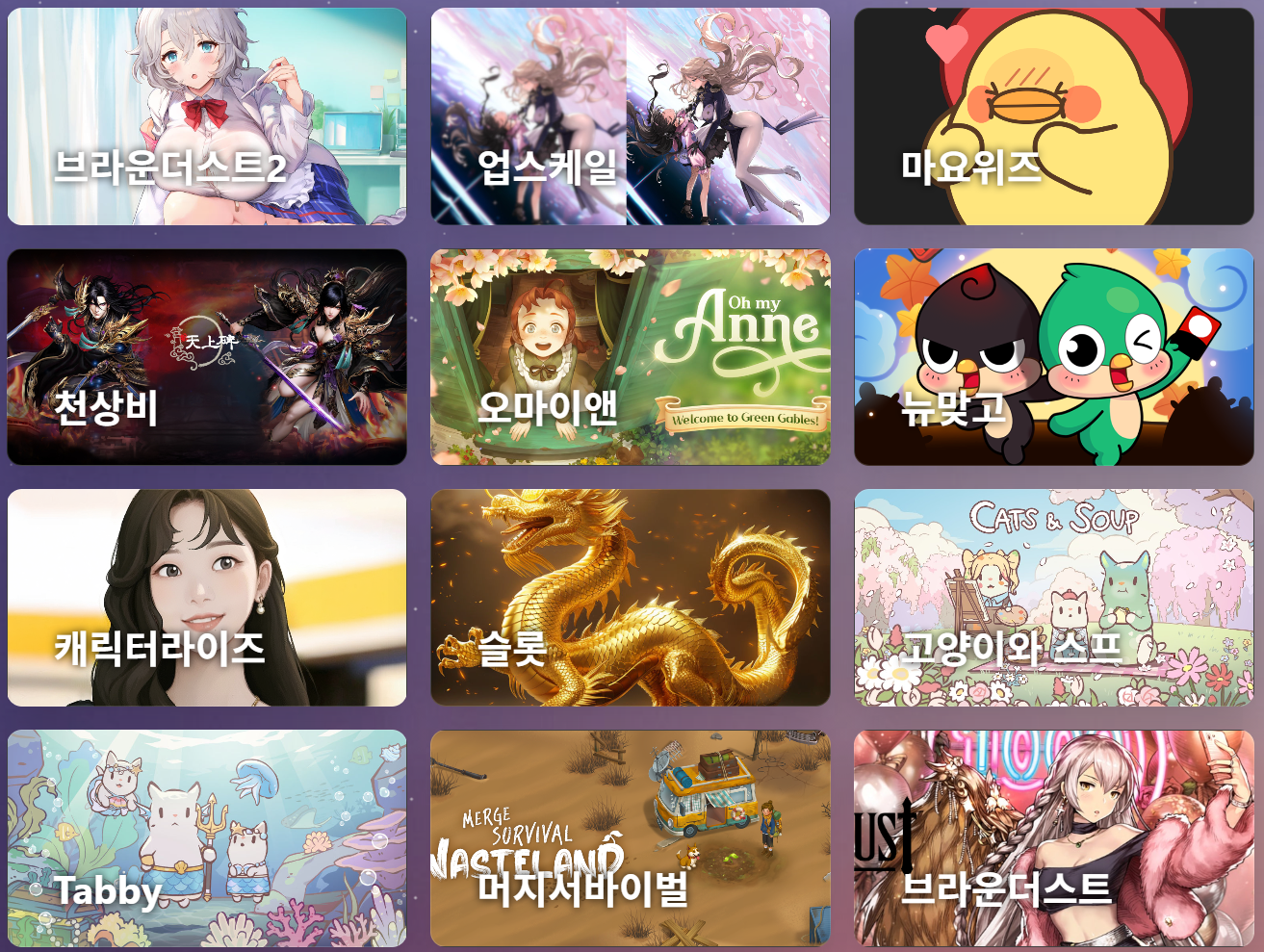
An internal AI service for controllable, title-specific image generation across diverse game art workflows.
This project focused on building and operating an internal generative image service for multiple game teams with distinct visual styles and production needs. Rather than supporting a single image-generation task, the service was designed to cover a broad range of artist workflows, including concept ideation, sketch completion, style transfer from real-world references, turnaround illustration, and multi-view drawing generation for downstream 3D production.
The central challenge was not simply generating high-quality images, but doing so in a way that remained consistent with each title's art direction and reliable enough for repeated use in production.
I developed task-specific ComfyUI workflows and continuously updated them as the field evolved, integrating new controllable generation methods for structure guidance, identity preservation, style adaptation, layered composition, and reusable editing pipelines.
The service was shaped through direct iteration with artists across seven internal IPs over more than two years, which meant balancing visual quality against practical concerns such as repeatability, consistency, latency, and ease of use.
Instead of treating new models and papers as isolated experiments, I evaluated and incorporated them as modular components within a production-oriented system for IP-constrained image generation.
- Built and operated an internal generative image service that supported multiple art-production tasks under title-specific style constraints.
- Designed and refined task-specific workflows by integrating controllable generation techniques for structure guidance, identity preservation, style adaptation, and iterative editing.
- Worked directly with artists across seven internal IPs to improve workflow usability and reduce repetitive reference-sharing and iteration overhead in daily production.
The service was adopted across seven internal game projects over more than two years, including support for a Google Play-recognized mobile title that exceeded 80 million downloads.
Internal artist feedback indicated that, for some workflows, the system substantially reduced repetitive sharing of prior references and visual examples, with one interview estimating roughly a 60% reduction.
More broadly, this project showed that the practical value of generative models in game art production depends less on raw model novelty and more on whether they can be made controllable, consistent, and reliable enough for real artist workflows.
In production art pipelines, the hardest problem is rarely image generation itself; it is building a controllable and IP-consistent system that remains useful across heterogeneous tasks, evolving models, and real artist workflows.